WHAT IS BLUNDERBUSS CANAL
Definition
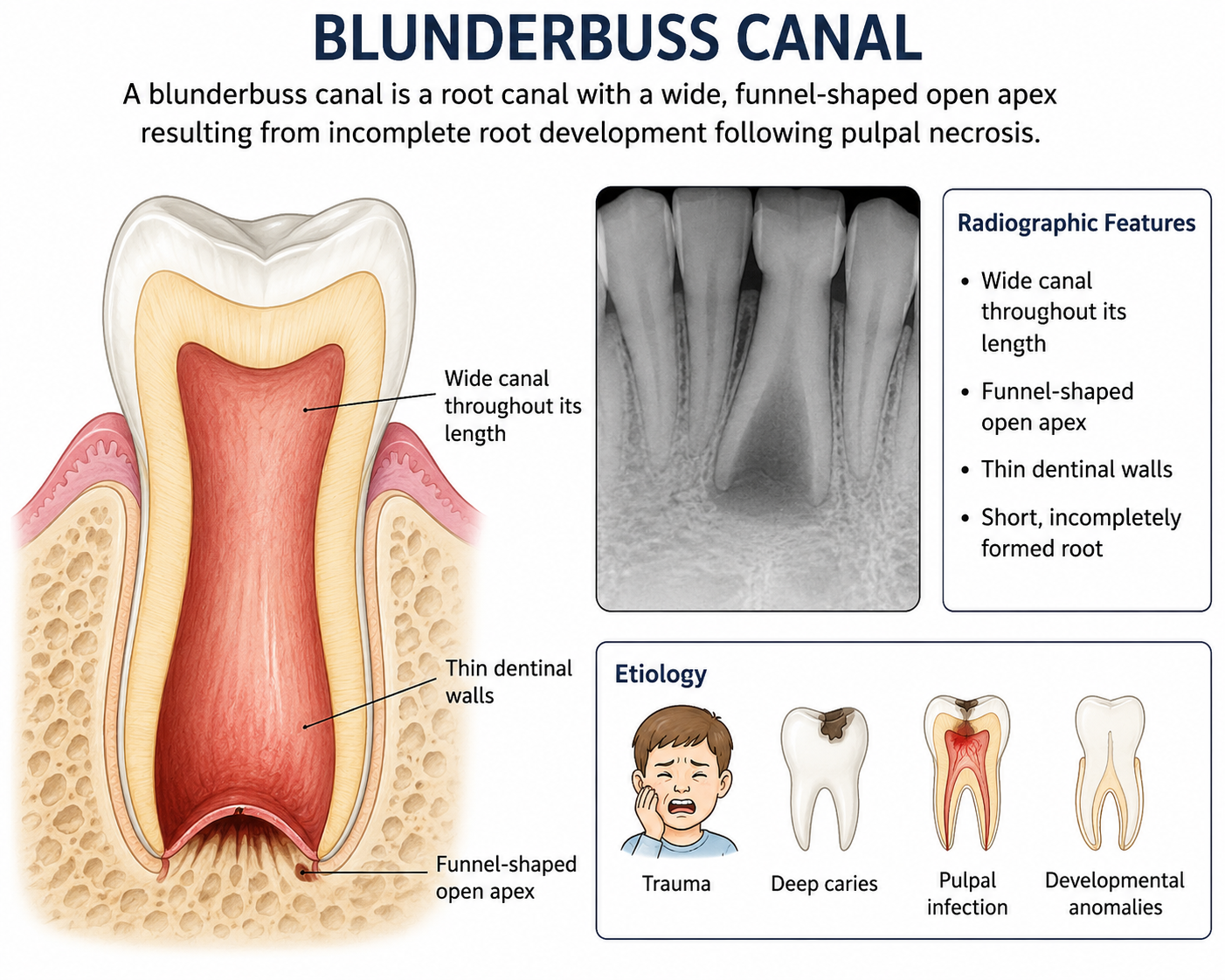
A blunderbuss canal is a root canal with a wide, divergent, funnel-shaped open apex resulting from incomplete root formation leading to pulpal necrosis.
Because the pulp becomes non-vital before root formation is complete, dentin deposition ceases, leaving thin dentinal walls and a flared apical opening.
Etiology
- Dental trauma (most common cause)
- Deep dental caries
- Developmental anomalies
- Pulpal infection
- Iatrogenic injury
When pulp vitality is lost before root maturation, Hertwig’s epithelial root sheath cannot continue normal root development, resulting in an open apex.
Pathogenesis
Root formation depends on a healthy pulp. In immature teeth, odontoblasts continue depositing dentin until the root reaches its normal length and the apical foramen narrows.
If pulp necrosis occurs early:
- Root development stops.
- Apical closure fails.
- The canal remains wide.
- The root walls stay thin and fragile.
- The apex assumes a funnel-shaped appearance.
Clinical Features
Patients commonly present with:
- History of trauma in childhood
- Discolored tooth
- Pain may or may not be present
- Swelling or sinus tract if infection exists
- Negative response to pulp vitality tests
- Increased mobility in severe cases
- Thin root structure prone to fracture
Radiographic Features
Radiographs typically reveal:
- Wide canal throughout its length
- Funnel-shaped open apex
- Thin dentinal walls
- Short, incompletely formed root
- Periapical radiolucency when infection is present
- Lack of normal apical constriction
Diagnosis
Diagnosis is based on:
- Patient history
- Clinical examination
- Pulp vitality testing
- Percussion and palpation tests
- Intraoral periapical radiographs
- CBCT when additional anatomical information is required
Treatment
- Eliminate microorganisms.
- Preserve remaining tooth structure.
- Achieve an apical barrier.
- Prevent reinfection.
- Restore function and aesthetics.
Treatment Options
1. Apexification
Apexification is indicated for non-vital immature permanent teeth with open apices.
Calcium Hydroxide Apexification
Traditionally, calcium hydroxide paste is placed inside the canal to stimulate the formation of a calcified apical barrier.
Advantages
- Long clinical history
- Effective apical barrier formation
Disadvantages
- Requires multiple appointments
- Long treatment duration (months)
- Increased risk of cervical root fracture
- Requires good patient compliance
2. MTA Apexification
Mineral Trioxide Aggregate (MTA) is commonly used to create an artificial apical barrier.
Procedure
- Access cavity preparation
- Minimal canal instrumentation
- Copious irrigation
- Canal disinfection
- Placement of a 3–5 mm MTA apical plug
- Moist cotton pellet placement
- Temporary restoration
- Permanent obturation after MTA sets
Advantages
- Short treatment time
- Excellent sealing ability
- Biocompatible
- Promotes hard tissue healing
- High success rate
Disadvantages
- Higher cost
- Technique sensitive
- Difficult manipulation
3. Regenerative Endodontic Procedure (Revascularization)
This biologically based treatment aims to restore vital tissue within the canal and allow continued root development.
Indications
- Immature permanent tooth
- Necrotic pulp
- Wide open apex
- Cooperative patient
Advantages
- Continued root development
- Thickening of dentinal walls
- Increased root length
- Reduced fracture risk
Limitations
- Variable outcomes
- Possible tooth discoloration
- Strict case selection required
Irrigation Considerations
Because of the open apex:
- Avoid excessive irrigation pressure.
- Use side-vented needles.
- Keep the needle short of the working length.
- Prevent extrusion of irrigants into periapical tissues.
Obturation
Obturation should provide a complete seal without overextension.
Common materials include:
- Mineral Trioxide Aggregate (MTA)
- Bioceramic materials
- Warm gutta-percha after apical barrier formation
Conclusion
A blunderbuss canal represents a challenging endodontic condition associated with immature permanent teeth that lose pulp vitality before root development is complete. Successful management requires careful diagnosis, thorough canal disinfection, and selection of an appropriate treatment approach. While calcium hydroxide apexification remains a proven method, MTA apexification and regenerative endodontic procedures have become preferred options because they reduce treatment time and improve long-term outcomes. Early diagnosis and appropriate management help preserve the affected tooth and maintain its function.
If you found this blog helpful, you can follow me on social media as well for any assistance. thank you for stopping by and reading the blog.
About The Author