Dental Implants
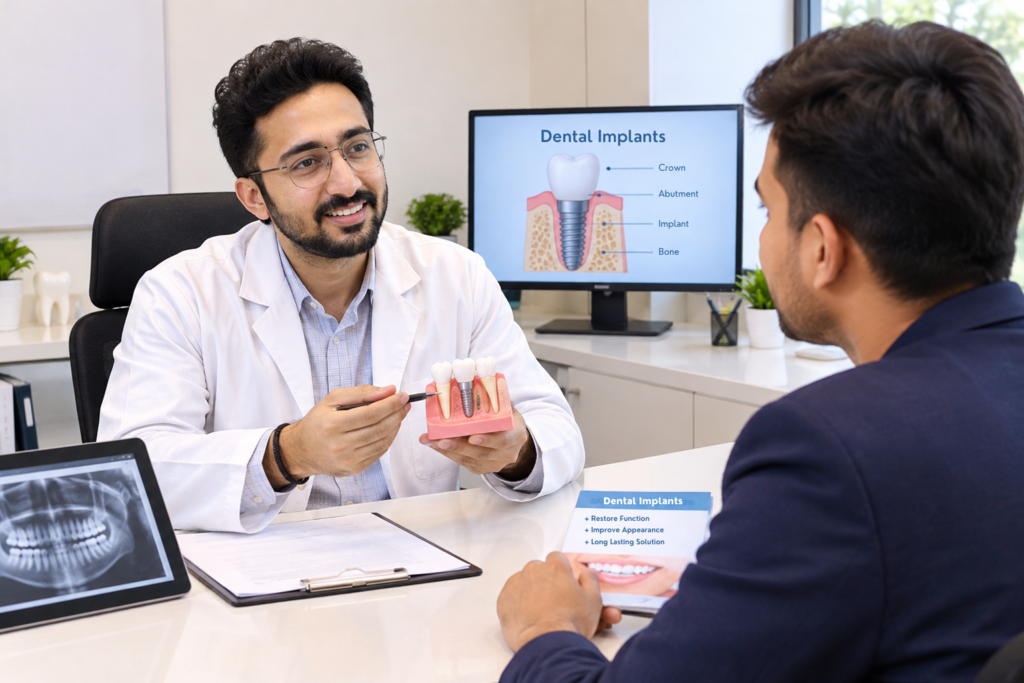
Dental implants are a common surgical tooth replacement option.They provide support for artificial teeth like crowns,bridges and denture.Dental implants have become the gold standard for tooth replacement, offering a permanent, natural-looking solution.
What are the dental implants
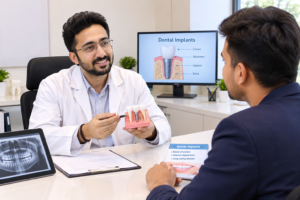
A dental implant is a titanium post that’s surgically placed into the jawbone to act as an artificial tooth root. Once it fuses with the bone in a process called osseointegration, a custom-made crown is attached on top, giving you a replacement tooth that looks, feels, and functions like a natural tooth. Unlike dentures or bridges, implants are anchored directly into the bone, making them the most stable.
Part of a dental implants
- Threaded post
- Abutment
- Restoration
Type of dental implants
1. Endosteal Implants
The most common type, these are placed directly into the jawbone, usually shaped like small screws. They’re suitable for most patients with adequate bone density.
2.Subperiosteal Impants
Placed under the gum but on or above the jawbone, these are used for patients who don’t have enough healthy jawbone and don’t want bone augmentation surgery.
3.Full arch/Full Mouth Implant
A technique using four (or more) implants to support a full arch of replacement teeth — ideal for patients missing most or all of their teeth.
Treatment Details
1.Initial Consultation & Planning
X-rays, 3D scans, and a full oral evaluation to assess bone density and plan implant placement.
2.Tooth Extraction (if needed)
Remaining tooth structure removed if needed.
3.Tooth Extraction (if needed)
If the jawbone lacks sufficient density, a graft may be needed to build a stable foundation.
4.Implant Placement
The titanium post is surgically inserted into the jawbone.
5.Osseointegration
A healing period where the implant fuses with the bone.
6.Abutment Placement
A small connector piece is attached to the implant.
7.Crown Placement
A custom-made crown is fitted on top, completing the restoration.
Dental Implant Surgery
- Making a small incision in the gum to expose the jawbone.
- Drilling a precise hole to fit the implant.
- Placing the titanium implant into the bone.
- Closing the gum tissue over or around the implant.
The Healing Phase
Healing happens in two parts:
- Initial Gum Healing – Soft tissue recovery typically takes 1–2 weeks, during which mild swelling, soreness, and slight bleeding are normal.
- Osseointegration – The critical bone-fusion process takes anywhere from 3 to 6 months, depending on the patient’s bone quality, implant location, and overall health. Only after this is complete is the permanent crown attached.
During healing, patients are advised to eat soft foods, avoid smoking, maintain good oral hygiene, and attend follow-up visits.
Benefits of Dental Implants
- Natural look and feel
- Preserves jawbone health
- Improved chewing and speech
- Protects adjacent teeth
- Long-term durability
- Boosts confidence
How Long Do Dental Implants Last?
The titanium implant post itself can last 25 years or longer — often a lifetime — with proper care, since titanium integrates so strongly with bone. The crown on top typically lasts 10 to 15 years before it may need replacement due to normal wear. Longevity depends on:
- Oral hygiene habits (brushing, flossing, regular checkups)
- Avoiding smoking and excessive alcohol
- Not grinding or clenching teeth
- Regular professional cleanings and dental visits
About the Author
Dr. Suresh Bharti
📧 sureshbharti4699@gmail.com
About The Author