MAJOR CAUSE OF WISDOM IMPACTED TOOTH ,SYMPTOM, TOOTH PAIN AND TREATMENTS
cause of impacted wisdom tooth
Causes of Wisdom Tooth Impaction
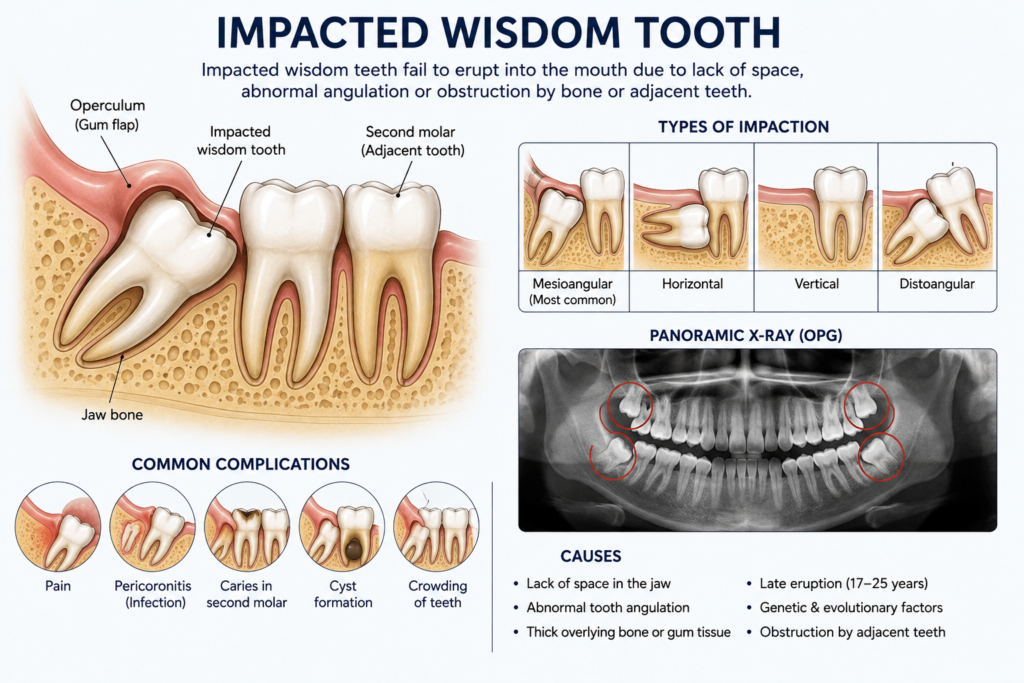
Wisdom teeth, also known as third molars, are the last permanent teeth to erupt into the oral cavity. They usually appear between 17 and 25 years of age. While some people have enough space for these teeth to erupt normally, many individuals experience problems because the wisdom teeth fail to erupt completely. Such teeth are called impacted wisdom teeth.
Major Causes of Wisdom Tooth Impaction
1.Insufficient Space in the Dental Arch
The most common cause of wisdom tooth impaction is lack of space in the upper or lower jaw.
Human jaws have gradually become smaller through evolution due to changes in diet and chewing habits. However, the number of teeth has remained the same. As a result, there is often inadequate room for the third molars to erupt.
When there is insufficient space:
- The tooth cannot erupt vertically.
- It may become trapped beneath the second molar.
- The eruption process stops before completion.
This is the leading reason why lower wisdom teeth become impacted.
2.Abnormal Tooth Angulation
Sometimes the wisdom tooth develops in an abnormal direction.
Instead of erupting vertically, it may grow:
- Towards the second molar (mesioangular)
- Away from the second molar (distoangular)
- Horizontally
- Vertically but blocked
- In unusual positions such as buccal or lingual inclination
3.Genetic Factors
Genetics plays a significant role in determining jaw size, tooth size, and eruption patterns.
A person may inherit:
- Small jaw size
- Large teeth
- Delayed eruption pattern
- Abnormal tooth positioning
If parents or close relatives experienced impacted wisdom teeth, the likelihood is often higher in other family members.
4.Evolutionary Changes
Anthropologists believe modern humans have smaller jaws than ancient populations.
Early humans consumed coarse, fibrous foods requiring powerful chewing muscles, resulting in larger jaws with adequate room for all teeth.
Modern diets are softer and require less chewing, leading to reduced jaw growth while maintaining the same number of permanent teeth.
5.Delayed Eruption
Wisdom teeth erupt much later than other permanent teeth.
By the age of 17–25 years:
- Most permanent teeth are already present.
- The dental arch has become crowded.
- Space available for eruption is limited.
The delayed eruption increases the possibility of impaction.
6.Dense Overlying Bone
Sometimes thick bone overlies the developing wisdom tooth.
This dense bone creates a mechanical barrier that prevents the tooth from erupting normally.
Bone-covered impacted teeth often require surgical removal.
7.Crowding of Teeth
Crowded dental arches reduce the available eruption space.
Although wisdom teeth are not considered the primary cause of anterior crowding in most individuals, existing crowding can contribute to impaction by limiting eruption space.
8.Developmental Disturbances
Abnormal development of the tooth germ can alter eruption direction.
Examples include:
- Rotation of the tooth
- Abnormal root formation
- Irregular crown orientation
- Ectopic development
These developmental changes increase the risk of impaction.
Symptoms of an Impacted Wisdom Tooth
Many impacted wisdom teeth remain symptom-free for years.
When symptoms occur, they may include:
- Pain behind the last molar
- Swollen gums
- Difficulty opening the mouth
- Pain during chewing
- Food trapping
- Bad breath
- Unpleasant taste
- Redness around the gum
- Facial swelling
- Jaw stiffness
Complications
If left untreated, impacted wisdom teeth may lead to:
1.Pericoronitis
Inflammation around a partially erupted wisdom tooth caused by bacterial accumulation beneath the gums.
2.Dental Caries
Food stagnation makes cleaning difficult.
Decay may develop in:
- Wisdom tooth
- Adjacent second molar
3.Cyst Formation
Fluid accumulation around the impacted crown may produce a dentigerous cyst.
Although uncommon, untreated cysts can enlarge and weaken the jaw.
4.Pain and Swelling
Repeated infection produces discomfort and affects daily activities.
Diagnosis
A dentist evaluates impacted wisdom teeth through:
Clinical Examination
includes:
- Gum swelling
- Pain
- Mouth opening
- Tooth visibility
- Infection
Radiographic Examination
Common imaging methods include:
- Intraoral periapical radiograph
- Orthopantomogram (OPG)
- Cone Beam Computed Tomography (CBCT) when indicated
Radiographs help determine:
- Tooth angulation
- Root morphology
- Relationship with the inferior alveolar nerve
- Bone coverage
- Surgical difficulty
Treatment
Treatment depends on symptoms and associated pathology.
Observation
Asymptomatic wisdom teeth without disease may be monitored with periodic clinical and radiographic examinations.
Medications
For acute infection:
- Pain relievers
- Antibiotics (when clinically indicated)
- Antiseptic mouth rinses
These manage symptoms but do not correct impaction.
Surgical Removal
Extraction is recommended when the impacted tooth causes:
- Recurrent pain
- Infection
- Caries
- Periodontal destruction
- Root resorption
- Cystic changes
- Orthodontic or prosthodontic problems
The procedure is performed under local anesthesia, and postoperative instructions help promote healing.
Can Wisdom Tooth Impaction Be Prevented?
True prevention is not always possible because genetics and jaw development play major roles. However, early dental assessment during adolescence can identify developing impactions. Timely monitoring allows the dentist or oral surgeon to plan treatment before complications arise.
Conclusion
Wisdom tooth impaction is primarily caused by insufficient space in the jaw, abnormal eruption direction, genetic influences, and developmental factors. Although some impacted wisdom teeth remain harmless, others may lead to infection, pain, tooth decay, periodontal disease, cyst formation, and damage to adjacent teeth. Early diagnosis through clinical examination and radiographic evaluation allows appropriate management and reduces the risk of long-term complications. Regular dental visits and timely consultation with a dentist or oral and maxillofacial surgeon are the best ways to maintain oral health and prevent serious problems associated with impacted wisdom teeth.
About The Author